Airbnb Welcome Book: What to Include (+ Free Template)
An Airbnb welcome book is a short guide, printed or digital, that gives guests everything they need to settle in: check-in steps, WiFi, house rules, appliance instructions and local recommendations, in the host's own voice. It should be scannable in under two minutes and answer the questions guests would otherwise text you.
Every host has answered the same five questions more times than they can count: what's the WiFi password, when's checkout, how does the shower work, where's good for dinner, is there parking. A welcome book doesn't get rid of the questions. It answers them before they're asked.
What is an Airbnb welcome book?
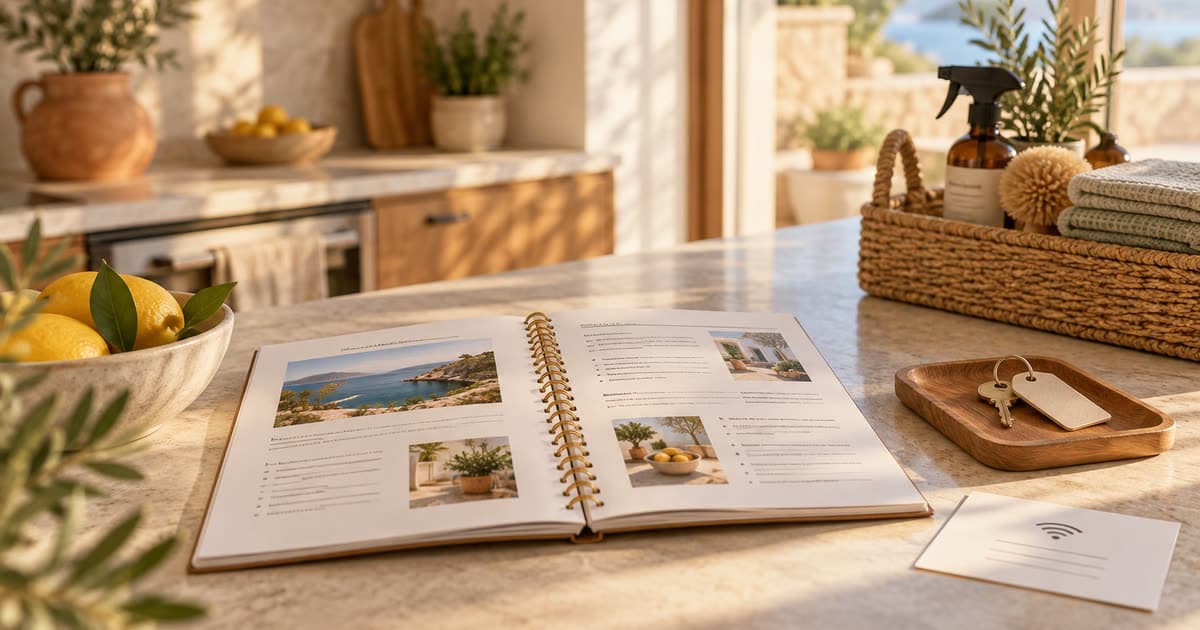
An Airbnb welcome book is a short guide, printed or digital, that gives guests everything they need to settle in: check-in steps, WiFi, house rules, appliance instructions and local recommendations, in the host's own voice.
It's not a legal document and it's not a brochure. It's closer to what you'd tell a friend staying at your place while you're out of town, written down once so you never have to say it twice.
What should an Airbnb welcome book include?
A welcome book earns its place if it covers everything a guest would otherwise have to text you about. At minimum, that's:
- Check-in and access — door code, keybox location, or smart lock instructions, with a photo if the entrance isn't obvious
- WiFi — network name and password, ideally also as a QR code guests can scan instead of typing
- House rules — quiet hours, smoking policy, pets, max guests, anything you'd actually enforce
- Appliance instructions — the coffee machine, the AC unit, the washer, anything that isn't self-explanatory
- Checkout steps — time, what to do with keys, trash, and towels
- Host contact — how to reach you, and for what (not everything is an emergency)
- Local recommendations — a short, real list, not a copy-pasted top ten
Everything past that list is optional. A welcome book that tries to cover every possible edge case stops being something guests will actually read.
The appliance section is the one hosts most often skip, and it's the one that generates the most messages. A coffee machine that looks obvious to you after three years of living with it is not obvious to a guest who's never seen that model. One photo and three lines — "Fill the tank here, one pod, press the middle button, wait 30 seconds" — replaces a message you'd otherwise get every single week.
Digital or printed welcome book — which is better?
Printed is what's physically in front of a guest at 11pm when the WiFi is down and their phone is at 4%. Digital is what's searchable, updatable in seconds when your parking situation changes, and reachable from a QR code by the door instead of a binder someone spilled coffee on in 2019.
Most experienced hosts end up using both, not as a duplication but as two entry points to the same information: a printed door hanger or laminated card as the physical fallback, and a digital guide — updated once, correct everywhere — as the actual source of truth guests are pointed to.
The practical difference shows up the first time your parking situation changes, or the WiFi provider swaps your password after a router reset. A printed page means reprinting, or worse, guests reading the wrong instructions until someone notices. A digital guide means you fix it once and every future guest — and every guest currently checked in, if they refresh the page — sees the correction immediately.
How long should an Airbnb welcome book be?
Short enough to scan in under two minutes on a phone screen, standing in a doorway with luggage. If a guest has to scroll past three paragraphs of house history to find the WiFi password, the book has already failed at its one job.
Length isn't really the metric that matters — findability is. A ten-page guide organized by question (with the WiFi password as the first thing on the page) beats a two-page guide written as a single block of prose.
What's a good example of a welcome book message?
The best welcome messages sound like a person, not a listing description. Compare these two:
"Welcome to our beautiful coastal retreat! We hope you have a magical stay filled with unforgettable memories."
"Hi, welcome in. WiFi's on the fridge, parking's the spot marked 4B, and the bakery two doors down does the best burek in the neighborhood — get there before 10am or it's gone."
Guests didn't book an Airbnb over a hotel to read marketing copy. They booked it because they wanted a local's actual take on the place — the second version is what delivers that.
The same rule applies to every section, not just the welcome line. "Please respect quiet hours" reads like a rule nobody wrote on purpose. "Quiet after 10pm — the walls are thin and the neighbors are lovely, let's keep it that way" is the same rule, and it's the one guests actually follow, because it explains the why instead of just stating the what.
Do guests actually read the welcome book?
Not cover to cover, and almost never before they arrive. Guests open it the moment they need one specific answer — usually within the first hour of check-in, and again around checkout. That's the real reason a welcome book organized as a list of questions works better than one written as a narrative: nobody reads the whole thing, everybody searches it.
How do I create an Airbnb welcome book (free template)?
Start from a template rather than a blank page, then go section by section and fill in what's actually true for your property — not a generic placeholder. A working structure looks like this:
- One line welcoming the guest by name, in your own voice
- Check-in: door code or lockbox, with a photo of the actual entrance
- WiFi network and password, as text and as a scannable QR code
- House rules that you'd actually enforce, not a legal boilerplate list
- Appliances a first-time visitor wouldn't recognize
- Checkout time and the two or three things you need done (keys, trash, nothing else)
- Three to five local recommendations, written like a text to a friend
- How to reach you, and when it's actually worth reaching you
Once it's filled in, read it once pretending you've never been to your city or your building. Anything you had to guess at, or anything you'd normally explain in person on arrival, is the section to go back and fix first.
If you'd rather not build one from scratch, bemyguest generates that full structure — check-in, house rules, appliances, checkout — from a short setup, and adds an AI concierge that can answer anything the book doesn't cover, in your own voice, at 2am if it has to.
What's the difference between a welcome book and a house manual?
In practice, none. "Welcome book" leans toward the friendly, guest-facing framing; "house manual" leans toward the operational one — the version a host might also use for a cleaner or co-host. The best version of either document is the same one: clear instructions, organized by question, written warmly enough that a guest actually reads it.
According to Google Keyword Planner, hosts across the US alone search variations of "airbnb welcome book" close to 500 times a month — which says less about the term itself and more about how many hosts are, right now, googling this instead of writing the thing.
Browse more of the guest guide series for house rules templates, check-in instructions, and appliance guides — or head back to the blog for everything else.
- —An Airbnb welcome book is a short guide, printed or digital, that gives guests everything they need to settle in: check-in steps, WiFi, house rules, appliance instructions and local recommendations, in the host's own voice.
- —Check-in and access instructions, WiFi network and password, house rules and quiet hours, appliance instructions for anything non-obvious, checkout steps, emergency and host contact info, and a short set of local recommendations.
- —Printed is what's physically in front of a guest at 11pm when the WiFi is down; digital is what's searchable, updatable in seconds, and reachable from a QR code by the door. Most hosts end up using both: a printed door hanger or folder as the fallback, and a digital guide as the source of truth.
- —Short enough to scan in under two minutes on a phone. If a guest has to scroll past a wall of text to find the WiFi password, the book has already failed at its one job.
- —Not cover to cover, and not before they arrive. Guests read it the moment they need one specific answer, which is why it needs to be organized by question, not by chapter.
Frequently asked questions
A digital guidebook handles the questions in this post automatically — house rules, local favorites, and an AI concierge that answers in your voice. Start your 14-day free trial →